OHSU Casey Eye Institute opens student-led clinic serving downtown, Portland-metro area

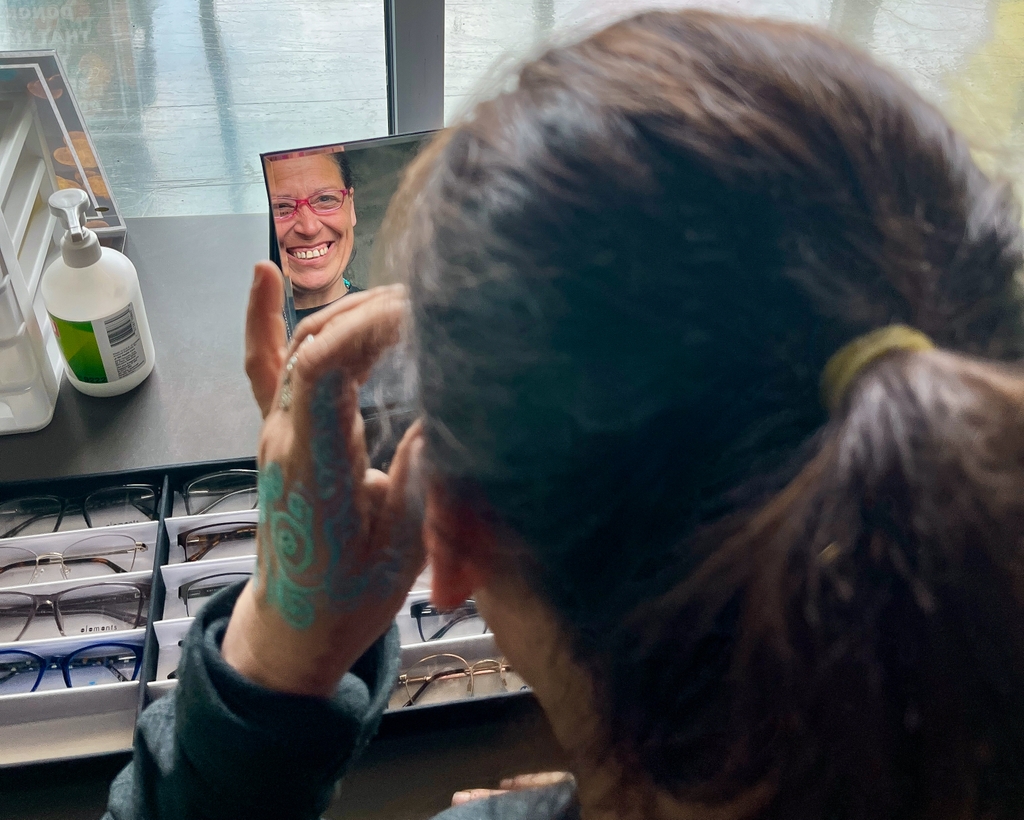
The Oregon Health & Science University Casey Eye Institute’s Community Outreach Program has expanded beyond its two mobile clinic services to include a fixed site in Portland, improving access to essential ophthalmology services for underserved community members.
The new clinic site, called Bridges to Sight, was established in collaboration with Transition Projects Inc., and the OHSU Bridges Collaborative Care Clinic, a community of medical and public health students working to provide free, low-barrier health care to Oregonians in need.
“Eye health is crucial for an individual’s quality of life, but so many Oregonians aren’t able to access critical health care to enhance and preserve their sight, including basic ophthalmology services like vision screenings and eyeglasses prescriptions,” said Andreas Lauer, M.D., director of OHSU’s Casey Eye Institute.
It will be permanently housed in downtown Portland at Transition Projects, Inc.’s headquarters and resource center, integrating ophthalmology services into existing medical, dental, pharmacy, public health and nursing care already being offered at the location.
Improving access
For over a decade, the Casey Eye Institute’s Community Outreach Program has operated a mobile eye clinic program that have reached more than 15,000 individuals across the state, with the goal of identifying sight-threatening conditions and providing accurate diagnosis, timely care and effective treatments.
But Oregon’s need has far outpaced the mobile clinics’ capabilities, prompting providers and faculty at the OHSU Casey Eye Institute to consider how to expand services. In the last few years, six community-based vision screening sites were created throughout smaller communities in Oregon with a seventh projected for next year, however, there is a growing need in the Portland-metro area.
Beginning April 11, Bridges to Sight will provide free eye care services, focusing on individuals who face challenges accessing care, including low-income and uninsured Oregonians.
“Our goal at OHSU Casey Eye Institute is to help eliminate preventable blindness,” Lauer said. “By providing the visual clarity essential for education, safety, and employment, proper eye care bolsters individual independence and builds more resilient, prosperous communities”
“We’re thrilled to open a fixed-site clinic, allowing us to offer these needed services to the community, and to focus on individuals with limited access for whom these services can be life-changing.”
Initially, services will be available to patients one Saturday each month, with the option of adding additional clinic days depending on community need and staffing.
The opening of this new, fixed-site clinic will reduce demand for the two mobile Casey Eye clinics to operate in Portland-metro area, freeing the mobile teams to provide care to more remote communities where barriers to care are different, Lauer said. Additionally, it expands access for metro-area partners who may otherwise wait one to two years for availability of mobile clinics.
Hands-on learning
Under the leadership of faculty adviser Lorri Wilson, M.D., associate professor of ophthalmology in the OHSU School of Medicine, Bridges to Sight will operate as a student-led clinic, providing a meaningful educational and community service opportunity for OHSU medical students to strengthen clinical skills and deepen exposure to ophthalmology.
Each clinic shift will include 1 to 3 medical students and 1 to 2 faculty — including physicians, residents and fellows — who can perform basic vision screenings, as well as comprehensive, fully dilated eye exams and refractions. Students will work with partners at Transition Projects, Inc. to facilitate follow-up care for patients with conditions that need more complex treatment, such as glaucoma.
Michael Aaby, a third-year medical student and leader of the ophthalmology student interest group in the OHSU School of Medicine, says the mentorship offered in the clinic is beneficial to both his academic trajectory and professional development as a medical provider.
“It’s such a great opportunity to get hands-on skills and learn from experts. It’s also been insightful working with different populations, especially those who face barriers in access to care. This experience will shape me into a more knowledgeable, effective provider.”
Aaby emphasizes that the work that will happen at Bridges to Sight represents essential health care that many would have gone without.
“Many people haven’t had an eye exam in decades, and some may have never had one in their whole life,” he says. “It's meaningful to be able to provide care and to see the joy on their faces when they try on their new prescriptions and can see clearly for the first time.”