OHSU first in Oregon to use robotic spine device

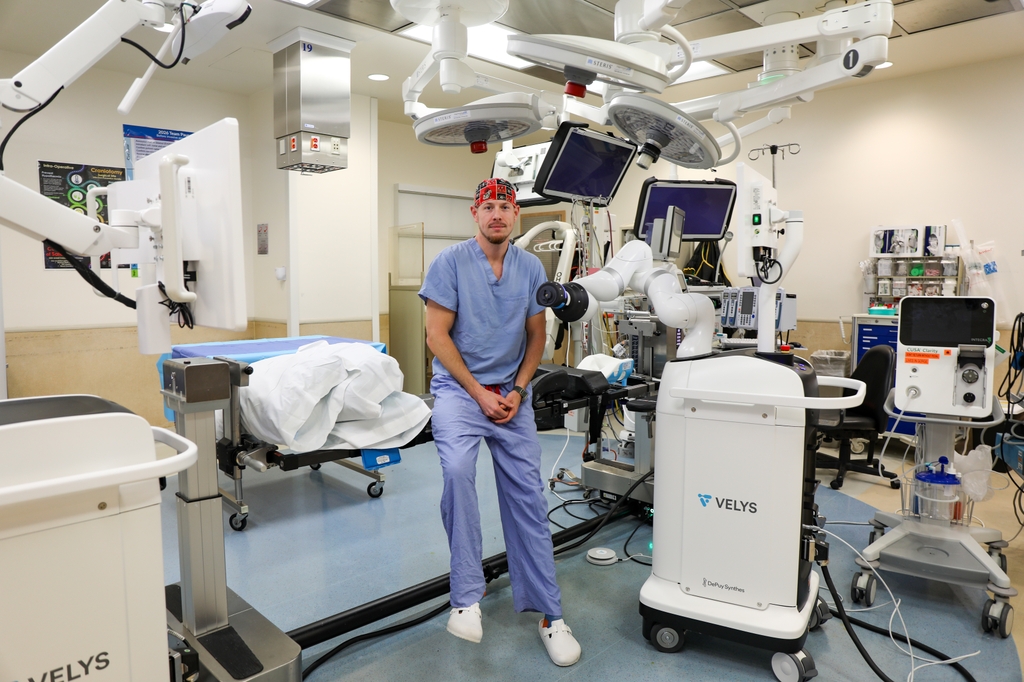
Spinal procedures at Oregon Health & Science University are benefiting from a new state-of-the-art robotic assist.
On April 3, OHSU became the first center in Oregon to use the second-generation robotic assistance device for spinal surgery. The tool — the first of its kind used at OHSU for spinal surgery — focuses on precision in a specialty where millimeters are crucial.

“We expect to use this tool several times a week going forward, and likely more as the program continues to grow,” said surgeon James Wright, M.D., assistant professor of neurological surgery in the OHSU School of Medicine.
The J&J VELYS Spine device enables surgeons to more precisely place spinal screws throughout the entire spine and pelvis.
Navigating and avoiding neural tissue normally requires a steady hand and intense focus.
The robotic device can be especially useful in longer cases that are technically challenging and require complex screw placement, or in those patients with abnormal anatomy. The device also is capable of adapting to the patient’s ever so slight real-time breathing and movement.
“The length and complexity of some of the longer cases we perform are mentally and physically taxing,” Wright said. “In straightforward and short cases, the robot increases our accuracy and may improve efficiency and safety. But in more complex cases that can span an entire day, with a very small margin of error, any tool that offsets some of the cognitive load is a welcomed improvement.”
Learn more about how OHSU is changing lives with innovative neurological procedures.
The OHSU Spine Center conducts an average of 1,000 surgical procedures annually, making it one of the busiest in the Pacific Northwest. Even though the center prioritizes least invasive options such as physical therapy first, many patients come from across the region in need of complex, specialty care that OHSU uniquely provides as the state’s academic medical center.
‘Profound’ relief
For Melanie Lyon, the spinal surgery at OHSU came only after she had seen more than a dozen health care professionals, ranging from primary care to chiropractic to rolfing.
“None of them could figure it out,” she said.
After six years of enduring gradually increasing sensation of pain shooting down her right side, the 50-year-old resident of the Columbia River Gorge in February finally received a referral to Wright. By then the pain was so persistent she could barely sleep. Magnetic resonance imaging, or MRI, revealed a slipped vertebrae so badly misaligned that she tilted as she walked upright.
On April 6, she became the second OHSU patient to undergo a procedure with the new robotic device.
Two days later, as she recovered in a room in OHSU’s Kohler Pavilion, she recounted feeling immediate relief from the underlying pain as she came out of general anesthesia. She’s looking forward to continued recovery as her spine heals so that she can resume doing the things she loves — especially dancing.
She’s grateful for the robotic technology that helped in her case. But she most credits the human care team at OHSU.
“The robot was a major assistant in what really was a human experience,” she said. “Dr. Wright has saved my life; there’s no question about that. The gratitude that I feel from being relieved of crushing pain, and to be given a new chance at life, is profound and hard to put into words.”