OHSU receives $8 million NIH grant to strengthen defenses against future pandemics

The COVID-19 pandemic underscored the importance of having the right research infrastructure in place before a crisis begins.
To help prepare for future outbreaks, Oregon Health & Science University has received an $8 million grant from the National Institutes of Health to create a state-of-the-art Biosafety Level 3, or BSL-3, laboratory on OHSU’s Marquam Hill campus. The grant, awarded through the NIH’s C06 Research Facilities Construction program, will support renovation of existing research space into a modern, high-containment laboratory designed to advance research on dangerous pathogens and emerging infectious diseases.
The new facility will replace OHSU’s current BSL-3 laboratory, which was built more than 30 years ago and has become limited in its capacity to support today’s infectious disease research needs.

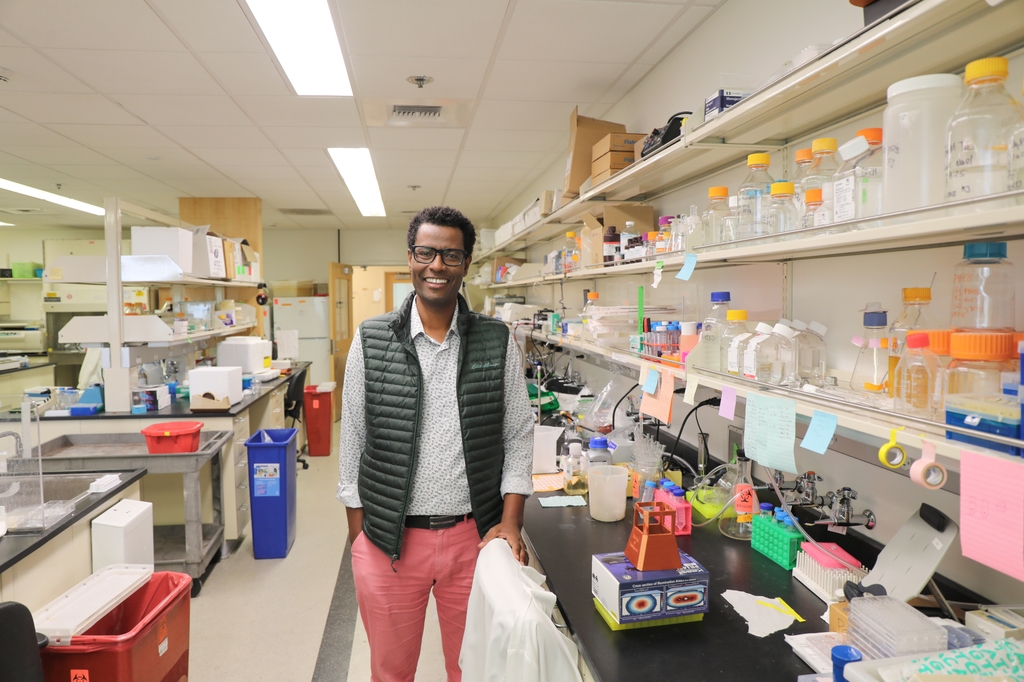
“The pandemic really brought to our attention that we need a bigger, safer facility,” said Fikadu Tafesse, Ph.D., professor and chair of microbiology and immunology in the OHSU School of Medicine, who led the grant application effort. “This $8 million NIH award is an exciting investment in OHSU’s future. It’s a critical and foundational investment in infrastructure, and we desperately need it. This facility will completely change the way we do science in infectious diseases.”
The award supports a broader institutional effort to modernize research infrastructure for studying dangerous pathogens while expanding opportunities for discovery and collaboration.

“Scientific breakthroughs begin with bold investments in people, ideas and infrastructure," said OHSU President Shereef Elnahal, M.D., M.B.A. “This new facility will empower OHSU researchers to tackle some of the most pressing infectious disease challenges of our time while preparing for those we have yet to face.”
Building capacity for tomorrow’s threats
BSL-3 laboratories are specialized facilities designed to safely study infectious agents that can cause serious disease in humans. At OHSU, researchers currently use the facility to investigate tuberculosis, yellow fever virus and SARS-CoV-2, among other pathogens.
Many emerging pathogens initially lack effective vaccines or treatments, making lab research essential for understanding how they spread and how to stop them.
“We know there will be another pandemic — it’s just a matter of time,” Tafesse said. “This facility is a game-changer for OHSU and for the region. It will allow us to do cutting-edge science on emerging and re-emerging pathogens, and help ensure we’re better prepared for future infectious disease threats.”
The new laboratory will be located on the seventh floor of OHSU’s Richard Jones Hall and is expected to take approximately three years to complete.

“OHSU faculty members have achieved great distinction in researching pathogens, understanding infectious disease and developing vaccines to protect us from harm,” said Nathan Selden, M.D., Ph.D., dean of the OHSU School of Medicine. “I am confident this new facility will advance and protect human health far into the future.”
Modernization, new approach methodologies
The existing BSL-3 laboratory was originally built for just one research track. Aging infrastructure and limited space have constrained the number and type of projects researchers can conduct simultaneously.

“The current BSL-3 space was built over 30 years ago specifically to study HIV,” said Bill Messer, M.D., Ph.D., associate professor of molecular microbiology and immunology, and medicine (infectious diseases) in the OHSU School of Medicine. “The facility is small, with only two workspaces, and maintenance is challenging, requiring custom repairs and long downtimes.”
The new facility will meet modern BSL-3 design standards and significantly expand research capacity. Plans include four dedicated research suites, two animal research suites, shared equipment areas, pass-through autoclaves and changing facilities for researchers.

The design also will make room for new approach methodologies, or NAMs, which are innovative research approaches that use technologies such as organoids and advanced human tissue models to reduce reliance on animal studies. Luiz Bertassoni, Ph.D., director of the OHSU Precision Biofabrication Hub, contributed to the NIH application, particularly the plans to bring advanced NAMs and organ-on-chip capabilities to the new laboratory that were not possible when the first BSL-3 lab was built.
“By designing dedicated NAMs spaces in the new BSL-3 facility, we can ensure that future pandemics and projects on infectious diseases can leverage the most advanced methods to study human health outside the clinic,” he said. “This will provide an important level of human-based information that can drastically accelerate how we fight diseases and prepare for future outbreaks.”
Advancing discovery
For researchers like Messer, whose laboratory studies mosquito-borne viruses such as yellow fever virus, the new facility will streamline the entire research process.
His team investigates how the immune system recognizes and protects against viral infections, work that requires studying live viruses under high-containment conditions.
“Today, we have to carefully plan around prolonged maintenance interruptions, and we’ve often needed to rely on other institutions for animal-based research,” Messer said. “The new BSL-3 space will allow us to conduct projects from beginning to end in one facility. That saves time, reduces costs and increases the likelihood that experiments can proceed successfully, without interruption.”
Tafesse said the upgraded facility will also help attract leading scientists, strengthening OHSU’s infectious disease research portfolio and supporting collaborations within OHSU and across the Northwest.
“It reflects a university-wide commitment to strengthening infectious disease research,” he said. “The research environment shapes the science that can be done. The right facilities allow us to ask questions and carry out studies that would otherwise be difficult or impossible. This award makes those opportunities possible.”
The NIH grant will fund a portion of the approximately $18 million project, with OHSU providing the remaining $10 million in support. University leaders, biosafety experts, engineers, facilities teams and researchers across multiple disciplines contributed to the successful application.
Once complete, the facility will serve as an institutional resource for investigators across OHSU and a regional asset for research partners who do not have access to their own BSL-3 laboratories.
“This investment positions OHSU for the future,” Tafesse said. “It will help us advance discovery, respond to emerging health threats and create new opportunities for scientific collaboration for years to come.”
This research is supported by the Office of the Director of the National Institutes of Health under award number 1C06OD042696. The content is solely the responsibility of the authors and does not necessarily represent the official views of the NIH.