Study challenges canonical understanding of hearing

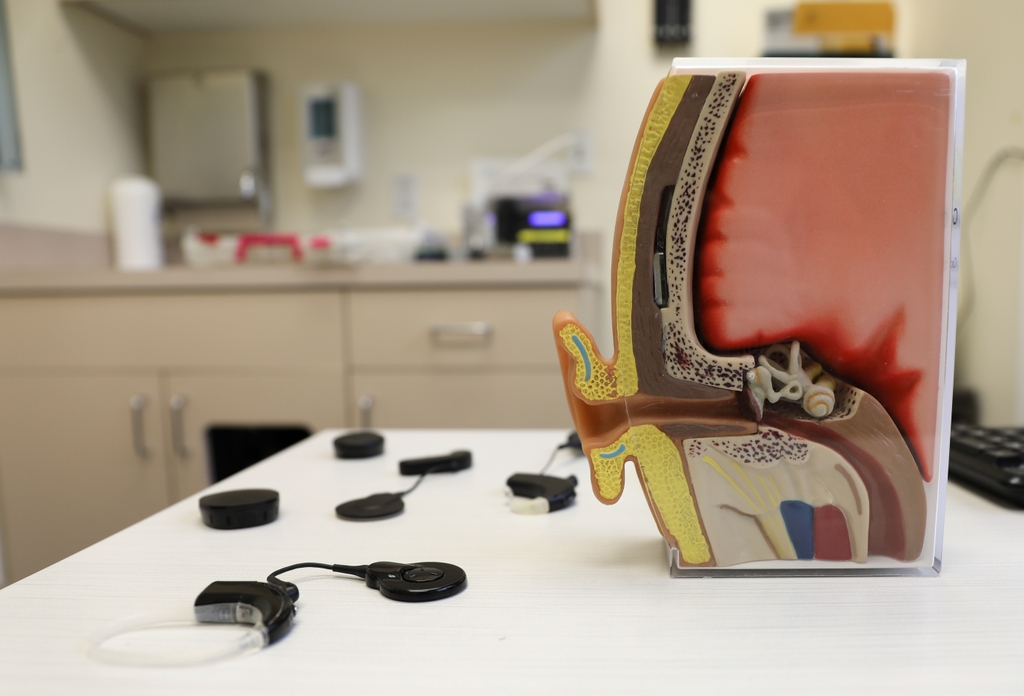
A study published today suggests a new understanding of how the inner ear processes sound, which could lead to improvements in hearing technology like cochlear implants.
The study, published in the journal Science Advances, included collaborators at Oregon Health & Science University, Linköping University in Sweden, the University of Michigan and the University of Washington.
The study, published in the journal Science Advances, included collaborators at Oregon Health & Science University, Linköping University in Sweden, the University of Michigan and the University of Washington.
Prevailing theory holds that the cochlea picks up different frequencies as if they’re keys on a piano: high frequencies ping the microscopic hair cells on one end of the coil-like membrane, while low frequencies activate the other end. This pattern enables detection of frequencies exceeding the speed of neurons. That assumption forms the basis of the technology behind cochlear implants, which are used worldwide to help people with hearing impairments.
However, researchers revealed this frequency-to-place understanding may need to be updated.
In guinea pigs, researchers were able to measure low-frequency vibrations not just in one particular spot on the cochlea, but almost simultaneously across distant regions.
Researchers said the finding suggests an opportunity to improve the design of cochlear implants so that people can pick up the rich complexity of vibrations across the cochlea that the brain translates into sound. High-frequency hearing is typically easier to study in research, whereas low-frequency hearing is much more challenging to study.
The new study suggests the “place code” understanding of hearing may be insufficient to fully reflect the complexity of sound.

“Cochlear implants are geared to take advantage of a place code,” said lead author George Burwood, Ph.D., research instructor in the Oregon Hearing Research Center at OHSU. “Our study suggests the optimal pattern of stimulation by electrodes in a cochlear implant may be more complex than just where and how intensely it’s being stimulated.”
Optical coherence tomography
Low frequencies are hard to study but crucial in the brain’s ability to translate complex patterns of speech.
“When you bring in low-frequency background noise, it’s a very challenging environment for people with hearing loss,” Burwood said. “Also, the place code paradigm limits the interpretation of how mammals evolved to detect extremely complex signals, especially speech.”
Today’s study casts new light on a canonical understanding of hearing.
In 1961, George von Békésy earned the Nobel Prize in Physiology or Medicine for discovering that different frequencies of sound — from low to high — stimulate distinct places on the coil-like membrane along the cochlea of the inner ear. The new research suggests processing between the inner ear and the brain is much more complex than a straightforward place code, at least in respect to low frequencies.

“This discovery advances our basic understanding in how hearing works,” said Laurence Trussell, Ph.D., director of the Oregon Hearing Research Center at OHSU. “The brain appears to have mechanisms that are able to differentiate frequencies without having a map or place code.”
Researchers made their discovery through use of optical coherence tomography, a biomedical technology co-invented by OHSU physician-scientist David Huang and commonly used in routine eye exams across the world.
Using OCT and novel postprocessing, scientists were able to cancel out noise and detect the signal of low-frequency sound registering at separate points of the guinea pig cochlea. Researchers found that low frequencies caused similar responses at points across the cochlea, with motion often synchronizing across large distances.
The discovery builds on previous research published in 2022 that first revealed the unexpected pattern of low frequency responses.

The late Alfred Nuttall, Ph.D., an OHSU professor of otolaryngology and longtime director of the Oregon Hearing Research Center who passed away in January, is a co-author on the publication.
Other co-authors include Pierre Hakizimana, Ph.D., Wajiha Zaidi and Anders Fridberger, Ph.D., of Linköping University; Karl Grosh, Ph.D., of the University of Michigan; and Ruikang K. Wang, Ph.D., of the University of Washington.
The research at OHSU was supported by the National Institutes of Health through award R01DC00141-44.
All research involving animal subjects at OHSU must be reviewed and approved by the university’s Institutional Animal Care and Use Committee (IACUC). The IACUC’s priority is to ensure the health and safety of animal research subjects. The IACUC also reviews procedures to ensure the health and safety of the people who work with the animals. No live animal work may be conducted at OHSU without IACUC approval.