
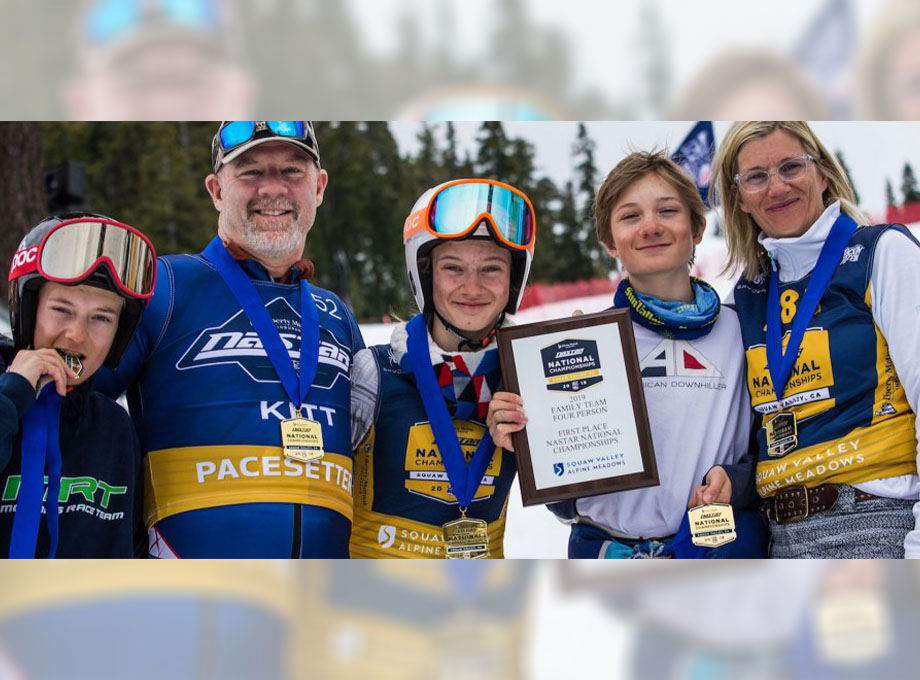
When retired, four-time Olympic skier AJ Kitt finally told his triplet children he had chronic myeloid leukemia, or CML, he was amazed by their reaction.
“We had waited years to tell them. You know, no one wants to tell your small children that you have cancer if you don’t have to, so we chose to wait. I think they were late junior high age. I wasn’t sure what they were going to do. And they were just like, ‘OK, can you pass the ketchup?” Kitt said. “It was just no big deal. And it’s been like that ever since. They’re 20 now, and they know exactly what it is. They’re as comfortable with it as I am.”

Kitt has been a patient of Brian Druker, M.D., CEO of the OHSU Knight Cancer Institute, since he was diagnosed 10 years ago. Druker’s research resulted in the drug Gleevec, which was approved by the Food and Drug Administration 25 years ago, on May 10, 2001. Gleevec turned a cancer that was once a death sentence into a manageable condition and to date has saved an estimated 350,000 lives globally, according to the nonprofit Blood Cancer United.
Gleevec, also known by its generic name imatinib, opened the door to what is known today as targeted therapy, or precision medicine. It paved the way for the development of hundreds of treatments that specifically kill cancer cells and leave healthy cells unharmed.
But for Kitt, Gleevec simply meant he got to live. As he explained to his then-teenage children, all those times he made the drive from their home in Hood River, Oregon, to Portland for medical appointments, it was to manage his CML.
“They just figured it was normal that Dad drove to Portland for doctor’s appointments,” he said.
By the time he told his children, his hemoglobin, platelets and white blood cells had all returned to normal levels, and he had been in remission for years.
“Dr. Druker had just had a conversation with me where he said, ‘AJ, you’re going to die of something someday, but it’s not going to be leukemia,’” Kitt said. “It was such a relief to hear that.”
Disbelief and confusion
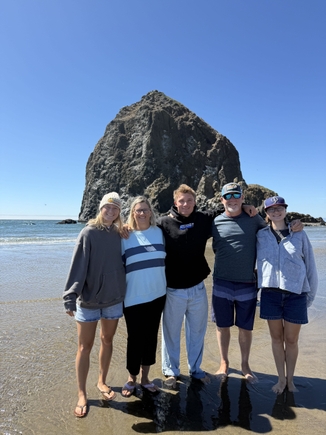
When he was diagnosed, Kitt remembers a completely different sensation — utter disbelief and confusion. At 46, he was fit and active, still skiing and coaching. The first American male alpine skier to compete in four Olympic games, Kitt made his debut at 19 in the 1988 Calgary games.
Kitt loved speed, and that’s how he lived his life — forward, faster, upward and onward. He specialized in Downhill and Super-G, creating countless unforgettable memories as a member of the U.S. Ski Team for more than a decade. By the time he retired from international competition in 1998, he had stood on 12 World Cup podiums, with four World Cup wins and four U.S. National Championships.
Retirement from racing didn’t slow him down. He and his wife, Amy, had triplets, two girls and a boy, gave them all A names — Ava, Ayden and Aksel — and split their time between Hood River and Vail, Colorado, with Kitt coaching youth ski teams in both locations.
Every winter, Kitt inevitably would come down with a sinus infection. Not one for regular medical appointments, he relied on a friend who was a physician to call in a prescription for antibiotics. But one winter, he called in the favor, and his friend told him he couldn’t do it — he had retired.
Kitt went to see a new family medicine physician for the first time in years, and that clinician noticed something during his physical — Kitt had an enlarged spleen.
“He was probing in my abdomen, and he said he felt something funny, so he ordered an ultrasound,” Kitt said. “Then they wanted bloodwork done. This all happened in one day, on a Tuesday. I got a call asking me to come in for an appointment at 4 p.m. that Friday. And the doctor says to me, ‘You’ve got leukemia.’ I was completely blindsided by it. I drove home in shock.”
He told his wife, Amy, who immediately told him to get back in the car. They drove back to the clinic, pounding on the door to get in because it had just closed for the weekend. The clinic staff let the couple in and gave them the name of a hematologist, a clinician who specializes in diseases of the blood, bone marrow and lymphatic system, at the local hospital. They called right away, but the hospital said that person didn’t work there anymore.
That weekend felt like the longest of his life. With his enlarged spleen, Kitt’s physician had told him he shouldn’t ski, because if he crashed, he could die from internal bleeding.
“I just felt like I was out on an island,” he said. “I was totally flailing.”
Appointment with Dr. Druker
Everyone noticed Kitt wasn’t skiing that weekend, and he told a few of the ski parents what he was dealing with. One of the ski moms was good friends with Druker’s wife. She made some phone calls and told Kitt to contact him Monday morning.
“I spent the rest of the weekend reading about CML and Googling Dr. Druker,” Kitt said. “I realized he was a big deal, like famous. But I texted him anyway, and he called me back. I’ll never forget that conversation. He said, ‘AJ, I’m in Houston at a medical conference, but I looked at your lab results. Can you be in my office Wednesday morning? You’re going to be fine. We’re going to take care of you.’ And I just lost it, I started sobbing.”
It was a rough start, but Druker was right. Kitt was fine in the end. First came a bone marrow biopsy, which Kitt describes as a painful procedure and recovery. Then he started taking Gleevec, with a goal of getting his white blood cell count to drop significantly.
His leukemia remained well-controlled for about a year and a half, and then his numbers started creeping up again. Druker told him this resistance to Gleevec was somewhat unusual, but several second-generation drugs were available for this situation. He put Kitt on Sprycel, and his leukemia again became well-controlled. Kitt has been in what’s called ‘deep molecular response,’ or deep remission, ever since.
In the last decade, Kitt has taken full advantage of the extension of life he received, traveling the world with his son Aksel, who has followed in his dad’s footsteps as a competitive skier. He and his wife also love following the pursuits of their daughters — Ava, who is a star lacrosse player at University of Maryland, and Ayden, who is studying aerospace engineering at Embry Riddle University in Daytona, Florida.
Gratitude is now a way of life for Kitt. The thought is never far from his mind that had he been diagnosed with CML in 1995 instead of 2005, his story would have had a very different outcome.
Druker remembers well what life was like before the Gleevec breakthrough.
“I remember the pre-Gleevec world,” Druker said. “People were headed for disaster, and there was nothing I could do about it. CML was one of the worst diseases anyone could deal with. I’d walk into the clinic and patients would be waiting for their blood counts. I would come in, and I’d have to say, ‘It’s time to get your affairs in order.’ That’s what it was like.”
Today, there are five drugs on the market for this leukemia. And in the last few decades, scientists have discovered many other uses for Gleevec. It is highly effective in treating gastrointestinal stromal tumors and in treating some skin cancers. It’s also used in transplant care, and to treat autoimmune diseases, allergies and fibrosis.
Celebrating a milestone
Knight School
Blood Cancer Then & Now: 25 Years of Innovation
What: An evening of presentations and celebration, featuring AJ Kitt, Olympian and cancer survivor; Brian Druker, M.D., CEO, Knight Cancer Institute; and Julia Maxson, Ph.D., associate professor, Division of Oncological Sciences, School of Medicine, Knight Cancer Institute.
When: Tuesday, May 19, 6 to 8 p.m.
Where: Knight Cancer Research Building, 2720 S. Moody Ave., Room 1015 (KCRB Auditorium)
Register (free): Register to attend the free event.
Accommodation: To request reasonable accommodation for this event, email KnightSchool@ohsu.edu
It’s incredibly gratifying, Druker said, to reach the milestone of 25 years since the FDA approved Gleevec.
“I remember what an uphill battle it felt like to get Gleevec into human clinical trials,” Druker said. “To get approval and funding for that. And then the excitement of seeing the drug work exactly as I had suspected that it would. It’s been the honor of my life to fight for my patients and to see Gleevec give hundreds of thousands of people their lives back.”
As for Kitt, he is working with Druker toward a day very soon when he will try and stop taking his medication entirely. In some patients with CML, being able to successfully stop treatment without disease recurrence is possible, and Kitt is a candidate. If his CML returns, he can go back on his medication and expect his leukemia to go back into remission.
Through it all, he said he’s still in awe that Druker’s discovery took a fatal cancer and turned it into a “pass the ketchup,” highly manageable diagnosis. And he’s filled with gratitude for his physician — a researcher and cancer institute executive who still insists on seeing patients every week.
“I can’t even begin to describe Brian — lifesaver, angel?” Kitt said. “I mean, I put myself in God’s hands with him. Brian is the smartest guy in any room he’s in, but he’s got the greatest bedside manner. He’ll just sit there and answer all your questions.
“The fact that he discovered and developed Gleevec and all the stuff he went through to get there, and then he sits by your bed and holds your hand; he’s just remarkable.”