
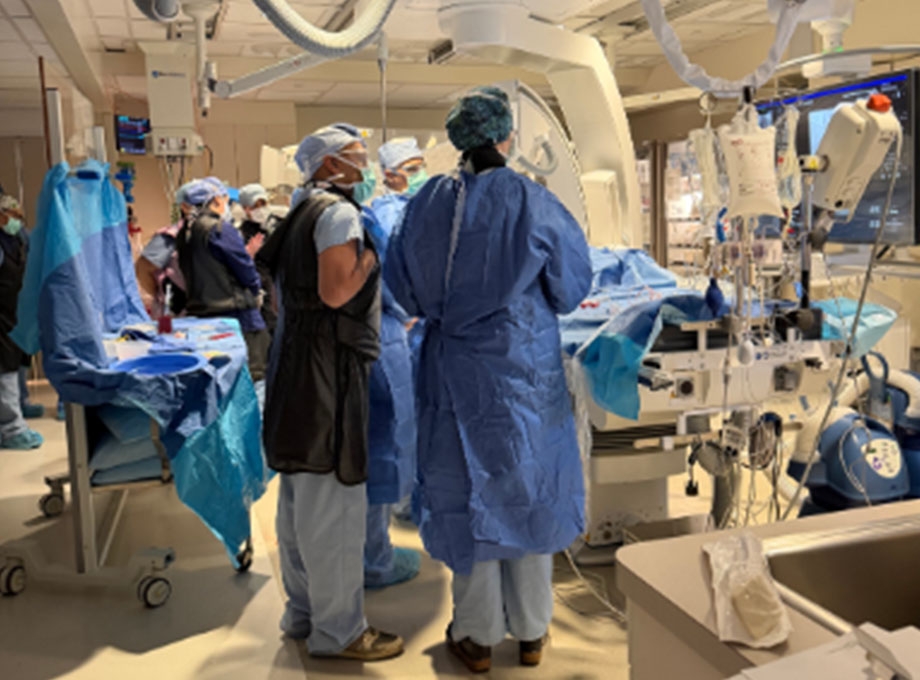
A team at Oregon Health & Science University is the first in the Pacific Northwest to perform a procedure that floods cancerous cells in the liver with high doses of a potent chemotherapy drug — and then removes it with a surgical trap before it can circulate through the rest of the body.
Known as Hepzato percutaneous hepatic perfusion, the procedure was approved by the Food and Drug Administration in August 2023. OHSU became the first center in the Pacific Northwest to use it with a case that was completed on March 17. The 68-year-old patient, who has a rare form of ocular cancer that metastasizes to the liver, was discharged the following day.
The sophisticated procedure required a large, closely coordinated team.
“It went about as smoothly as could be,” said interventional radiologist Khashayar Farsad, M.D., Ph.D., professor and chair of interventional radiology in the OHSU School of Medicine and director of the Dotter Institute at OHSU. “That’s how the patient was able to go home the next day.
“Without this technique, this would have been a major operation with full exposure of the liver. This new technique is truly a revolutionary difference in how this treatment can be performed.”
The procedure is another demonstration of OHSU’s role as the state’s academic medical center to deliver specialty, multidisciplinary care, Farsad said.
“We’re looking forward to increasing our bandwidth to support these types of innovative, cross-disciplinary cancer therapies for our patients,” he said. “We see opportunities for impactful clinical trials where OHSU can be a national leader.”
This new intervention could be expanded to other forms of targeted delivery of high-dose chemotherapy in future clinical trials, he said.
A mole in the eye
For now, the procedure is limited to a rare form of cancer, uveal melanoma, that begins in the eye but can metastasize to other organs, most commonly the liver. The cancer usually arises from benign tumors often referred to as “freckles” — or more accurately “moles” — in the eye that eye doctors will sometimes observe in routine eye exams. Even in patients who undergo successful treatment of the eye tumor, uveal melanoma has a high risk for spread to the liver.

“It’s important for anyone who’s told they have a freckle or mole in the eye to understand they need lifelong monitoring with eye exams,” said Alison Skalet, M.D., Ph.D., FACS, the Paul H. Casey Chair and division director of ocular oncology in the OHSU Casey Eye Institute. “They can turn into melanomas, and they can become very aggressive.”
She said benign moles, called choroidal nevi, can be relatively common. But an estimated 1 in 8,000 transforms into melanoma. Patients usually don’t experience symptoms such as shadowy sight or retinal detachments until tumors have grown large, which is why periodic eye exams are important for early diagnosis. Early treatment of smaller tumors is typically associated with lower risk for the cancer to spread.
“The liver is by far the most common site of metastasis,” Skalet said. “That’s what most commonly kills patients with this disease.”
Direct delivery of chemotherapy drug
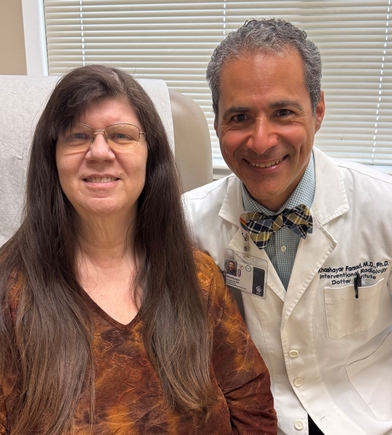
In the case of the patient treated in March at OHSU, the medical team used the new technique to flood the liver with high doses of the chemotherapy drug melphalan, targeting cancerous cells. The interventional radiology team, led by Farsad, effectively used the tumor’s own blood supply against itself by tapping into an artery to deliver the drug in, and isolating the major veins to filter the saturated blood flowing out.
“It isolates the liver’s blood vessel circuitry,” Farsad said. “It means we can deliver chemotherapy to kill cancerous cells in the liver, and then extract the drug before it ever gets a chance to get into circulation in the rest of the body.
“We consider it a minimally invasive technique.”
Even though it may be minimally invasive in the technical sense, in the practical sense it required a large and highly coordinated team of specialists including medical oncologists with the OHSU Knight Cancer Institute, anesthesiology, perfusion, pharmacy and ophthalmology.

“This procedure provides patients with an option they otherwise wouldn’t have,” said medical oncologist Matthew Blackburn, M.D., clinical associate professor of medicine in the OHSU School of Medicine.
Patient Christine “Chris” Lines of Sweet Home said she understands the prognosis for her condition is a matter of months as opposed to years, but she’s grateful for the chance. She’s also gratified she didn’t have to leave the state.
“I’m hoping to make it to another Christmas,” she said. “I’m feeling more confident that I’ll make it to the end of the year. Who knows, maybe they’ll come up with something else in the meantime.”