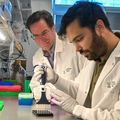
New blood test identifies hard-to-detect pancreatic cancer with 85% accuracy
Jared Fischer, Ph.D., left, and Jose Luis Montoya Mira, Ph.D., cancer researchers at OHSU, have developed PAC-MANN, a test that uses a small blood sample to detect changes in protease activity, a key indicator of the most common and deadliest form of pancreatic cancer. (OHSU/Christine Torres Hicks)
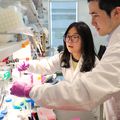
Making cancer treatment safer and more effective
Li Xiang, Ph.D., postdoctoral scholar at the OHSU Knight Cancer Institute, and Michael Henderson, B.A., biomedical engineering Ph.D. student, are part of a team that developed a new nanoparticle that makes cancer treatment safer and more effective. (OHSU/Christine Torres Hicks)
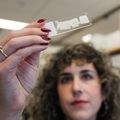
Researchers identify kidney sensor that helps control fluid balance
Rose Hill, Ph.D., studies sensory nerves within the kidneys at OHSU. Her new study identified a protein that acts as a pressure sensor in the kidneys, which helps the body control fluids and blood pressure. (OHSU/Christine Torres Hicks)
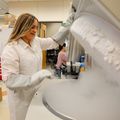
Burwitz lab - studying hepatitis B virus
Lauren Rust, Ph.D., assistant staff scientist, opens a cryogenic freezer in the lab of Benjamin J. Burwitz, Ph.D., in the Oregon National Primate Research Center. Burwitz and Rust have developed the first transgenic nonhuman primate model — genetically modified to carry a human gene — for studying hepatitis B virus. (OHSU/Christine Torres Hicks)

Ariel Shaak
OHSU patient and employee Ariel Shaak holds her daughter, Makenna. She said she is thankful to have a family of her own after a difficult cancer journey. (OHSU/Christine Torres Hicks)

Improving access to contraception
The first over-the-counter birth control pill has been approved for sale in the United States. The milestone allows people to access daily oral contraception without a prescription for the first time. (OHSU/Christine Torres Hicks)
Review suggests ending adult boosters for tetanus, diphtheria
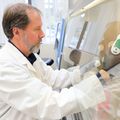
Mark Slifka, Ph.D., works in his lab at OHSU. A new review led by Slifka, suggests dropping precautionary booster vaccinations in the U.S. for tetanus and diphtheria among adults who have already gone through their childhood vaccination series. This would be similar to guidelines by the World Health Organization, the United Kingdom and in how the U.S. currently recommends vaccination for other infectious diseases. (OHSU/Christine Torres Hicks)
OHSU patient twice receives lifesaving kidney from her own family 34 years apart
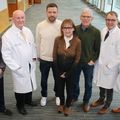
Kidney transplant recipient Susan Posner, center, received life-saving kidney donations 34 years apart at Oregon Health & Science University. In a special gathering at OHSU on March 31, she is flanked by her nephew, David Hawker, left, and brother, Ian Hawker, right. The medical team includes, left to right, Chris Connelly, M.D., John Barry, M.D., David Woodland, M.D., and Oren Shaked, M.D. (OHSU/Erik Robinson)

OHSU Doernbechers Pediatric Heart Care team provides life-saving care to infant with rare congenital condition 1
Bear Anderson and his parents, Misha and Jeff Anderson, attend a routine visit with OHSU Doernbecher’s Pediatric Heart Care Team. After being diagnosed with a rare congenital condition before birth, Bear now receives ongoing, comprehensive care at OHSU. (OHSU/Christine Torres Hicks)
Isabella Rauch, Ph.D.
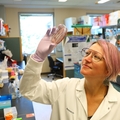
Isabella Rauch, Ph.D., es la autora principal de un nuevo estudio publicado en la revista Nature que revela cómo una cepa peligrosa de E. coli bloquea las defensas inmunitarias del cuerpo para propagar la infección. (OHSU/Christine Torres Hicks)
