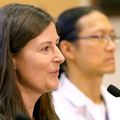
Fatemeh
Reshad family attoney Jennifer M. Morrissey, J.D. speaks at a press conference on February 4, 2017. Doctors at OHSU Doernbecher Children's Hospital in Portland announced that Fatemeh Reshad, an infant from Iran with a life-threatening heart condition, will be allowed to come into the U.S. and have surgery. (OHSU/Kristyna Wentz-Graff)
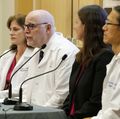
Fatemeh
Dana Braner, M.D., F.A.A.P., F.C.C.M., physician-in-chief and chair of the Department of Pediatrics, speaks at a press conference on Saturday, February 4, 2017. Doctors at OHSU Doernbecher Children's Hospital in Portland announced that Fatemeh Reshad, an infant from Iran with a life-threatening heart condition, will be allowed to come into the U.S. and have surgery. (OHSU/Kristyna Wentz-Graff)
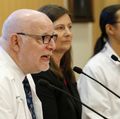
Fatemeh
Dana Braner, M.D., F.A.A.P., F.C.C.M., physician-in-chief and chair of the Department of Pediatrics, speaks at a press conference on Saturday, February 4, 2017. Doctors at OHSU Doernbecher Children's Hospital in Portland announced that Fatemeh Reshad, an infant from Iran with a life-threatening heart condition, will be allowed to come into the U.S. and have surgery. (OHSU/Kristyna Wentz-Graff)
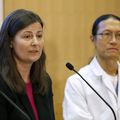
Fatemeh
Reshad family attoney Jennifer M. Morrissey, J.D. speaks at a press conference on February 4, 2017. Doctors at OHSU Doernbecher Children's Hospital in Portland announced that Fatemeh Reshad, an infant from Iran with a life-threatening heart condition, will be allowed to come into the U.S. and have surgery. (OHSU/Kristyna Wentz-Graff)
Fatemeh
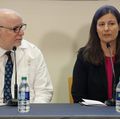
Dana Braner, M.D., F.A.A.P., F.C.C.M., physician-in-chief and chair of the Department of Pediatrics (left) listens as Reshad family attoney Jennifer M. Morrissey, J.D. speaks at a press conference on February 4, 2017. Doctors at OHSU Doernbecher Children's Hospital in Portland announced that Fatemeh Reshad, an infant from Iran with a life-threatening heart condition, will be allowed to come into the U.S. and have surgery. (OHSU/Kristyna Wentz-Graff)
Heart diagram
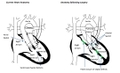
Four-month-old Fatemeh Reshad was born with a complex, life-threatening heart defect known as transposition of the great arteries, or TGA. TGA with ventricular septal defect affects approximately 2 in 10,000 newborns each year. Although this defect is rare, OHSU Doernbecher Children's Hospital and other congenital cardiac centers in the United States routinely care for children with this condition. In the United States, the standard approach for a child born with this defect is to perform heart surgery, typically within several days to several weeks of birth. Generally speaking, the surgery has a very high rate of success. (OHSU)
Mole Mapper app
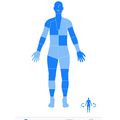
A screenshot from the Mole Mapper app, showing "maps" of mole locations across the body. (OHSU)
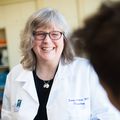
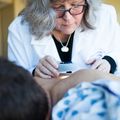
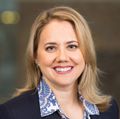
Sancy Leachman, M.D., Ph.D., performs a skin check.
Sancy Leachman, M.D., Ph.D., performs a skin check on an OHSU patient in 2015. (OHSU/Fritz Liedtke)
