
Lipid nanoparticle-based gene therapy
Oregon Health & Science University and Oregon State University researchers are developing a new approach to deliver gene therapy to address blindness-causing genetic mutations. Their new method encases gene-editing molecules inside a shell of lipid nanoparticles. This scientific illustration shows the approach's lipid nanoparticle shells, which appear as fuzzy beige balls after they have been injected into the eye. (OHSU/Tetiana Korzun)

Gaurav Sahay, Ph.D. (Courtesy)
OHSU researchers identify promising next-generation cancer treatment
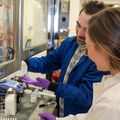
Michael Cohen, Ph.D., in his lab with Moriah Arnold, a student in the OHSU Graduate Program in Biomedical Sciences, School of Medicine. (OHSU/Christine Torres Hicks)
Michael Cohen Lab
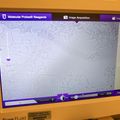
A microscope view of tumor-initiating cells used in the Cohen lab. (OHSU/Christine Torres Hicks)
Moriah Arnold and Michael Cohen
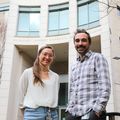
Michael Cohen, Ph.D., and Moriah Arnold, an M.D./Ph.D. student and co-author of the study unveiling a new class of PARP-1 inhibitors, stand outside the OHSU Biomedical Research Building on Friday, Feb. 10, 2023. (OHSU/Christine Torres Hicks)
Model - Cohen Lab
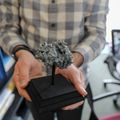
Michael Cohen, Ph.D., holds a molecular model. The red dot represents a small molecule inhibitor, which his team designed, in the binding pocket of its target protein. (OHSU/Christine Torres Hicks)
Chemistry discovery critical in cancer treatment
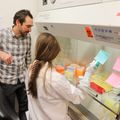
Michael Cohen, Ph.D., in his lab with Moriah Arnold, an M.D./Ph.D. student and co-author of the study unveiling a new class of PARP-1 inhibitors. (OHSU/Christine Torres Hicks)
Michael Cohen and Moriah Arnold
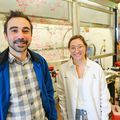
Michael Cohen, Ph.D., and Moriah Arnold, an M.D./Ph.D. student and co-author of the study unveiling a new class of PARP-1 inhibitors, in the Cohen lab inside the OHSU Biomedical Research Building on Friday, Feb. 10, 2023. (OHSU/Christine Torres Hicks)
Investigadores de OHSU identifican un promisorio tratamiento de ltima generacin contra el cancer
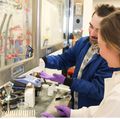
Michael Cohen, Ph.D., en su laboratorio con Moriah Arnold, MD/estudiante de doctorado y coautora del estudio en el que se descubrió una nueva clase de inhibidores de la PARP-1. (OHSU/Christine Torres Hicks)

