
Give Cancer Hell - Knight Cancer Institute logo
June 24, 2026

New developments in cancer
June 24, 2026
OHSU cancer researchers have developed PAC-MANN, a blood test that detects changes in protease activity, a key indicator of the most common and deadliest form of pancreatic cancer. (OHSU/Christine Torres Hicks)

New drug combinations could improve therapies for breast cancer other aggressive cancers
June 24, 2026

OHSU Knight Cancer Institute 2
June 24, 2026

OHSU Knight Cancer Institute
June 24, 2026
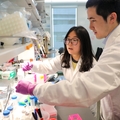
Novel cancer treatment research
June 23, 2026
Li Xiang, Ph.D., postdoctoral scholar at the OHSU Knight Cancer Institute, and Michael Henderson, B.A., a biomedical engineering Ph.D. student, are part of a research team at Oregon Health & Science University that developed a new nanoparticle designed to make cancer treatment safer and more effective. (OHSU/Christine Torres Hicks)
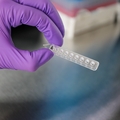
Organs-on-a-chip research and technology
June 23, 2026
A researcher holds a biofabrication tool tip in an OHSU lab, where scientists create advanced models such as organoids and organs-on-a-chip. These technologies allow researchers to study cancer in its earliest stages and better mimic the human body, offering new insight into how the disease begins. (OHSU/Christine Torres Hicks)
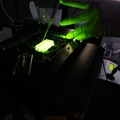
Molecular level
June 23, 2026
Specialized imaging equipment glows in a darkened lab at OHSU. Researchers use advanced imaging tools and techniques to study cancer at the molecular level, advancing early detection and new approaches to treatment. (OHSU/Christine Torres Hicks)
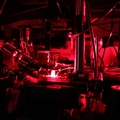
Advanced microscopy
June 23, 2026
Specialized imaging equipment glows red in a darkened OHSU lab. Using advanced microscopy techniques, researchers study cancer across molecular and cellular scales, supporting earlier detection and the development of new treatments. (OHSU/Christine Torres Hicks)
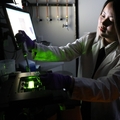
Advanced microscopy
June 23, 2026
Specialized imaging equipment glows in a darkened lab at OHSU. Researchers use advanced imaging tools and techniques to study cancer at the molecular level, advancing early detection and new approaches to treatment. (OHSU/Christine Torres Hicks)
