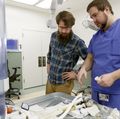
Total artificial heart prototype
(Left to right) Engineer Patrick Jurney and Igor Dykan, M.D., test a total artificial heart prototype Feb. 7, 2018, designed to permanently replace a failing heart for most adults and children age 10 or older. (OHSU/Kristyna Wentz-Graff)
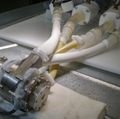
Total artificial heart prototype
A working prototype of OHSU's artificial heart, Feb. 7, 2018. Researchers are designing what they hope will be a total artificial heart that can permanently replace a failing heart for most adults and children age 10 or older. (OHSU/Kristyna Wentz-Graff)
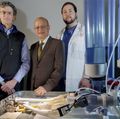
Total artificial heart prototype
(Left to right) George Giraud, M.D., Ph.D., Sanjiv Kaul, M.D., and Igor Dykan, M.D., who are helping OHSU to develop what they hope will be the first total artificial heart designed to permanently replace a failing heart for most adults and children age 10 or older. (OHSU/Kristyna Wentz-Graff)

Richard Wampler, M.D.
Richard Wampler, M.D., presents information on a total artificial heart prototype, to leadership at OHSU, April 3, 2017. OHSU is developing what researchers hope will be the first total artificial heart designed to permanently replace a failing heart for most adults and children age 10 or older. (OHSU/Kristyna Wentz-Graff)
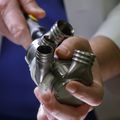
Total artificial heart prototype
OHSU is developing what researchers hope will be the first total artificial heart designed to permanently replace a failing heart for most adults and children age 10 or older. (OHSU/Kristyna Wentz-Graff)
Ion channel
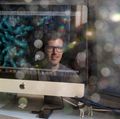
Researcher Nate Yoder looks at a cryo-EM density map, March 6, 2018 at the OHSU Vollum Institute. (OHSU/Kristyna Wentz-Graff)
Ion channel
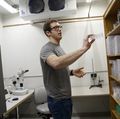
Researcher Nate Yoder looks protein crystals of acid-sensing ion channels grown at high pH, March 6, 2018 at OHSU Vollum Institute. (OHSU/Kristyna Wentz-Graff)
Ion channel
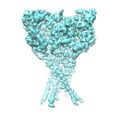
Scientists at OHSU used advanced imaging techniques to ascertain the resting state of an acid-sensing ion channel. This cryo-EM density map shows the atomic structure of a key molecular component of the nervous system. (OHSU)
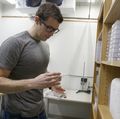
Ion channel
Researcher Nate Yoder looks protein crystals of acid-sensing ion channels grown at high pH, March 6, 2018 at OHSU Vollum Institute. (OHSU/Kristyna Wentz-Graff)
