
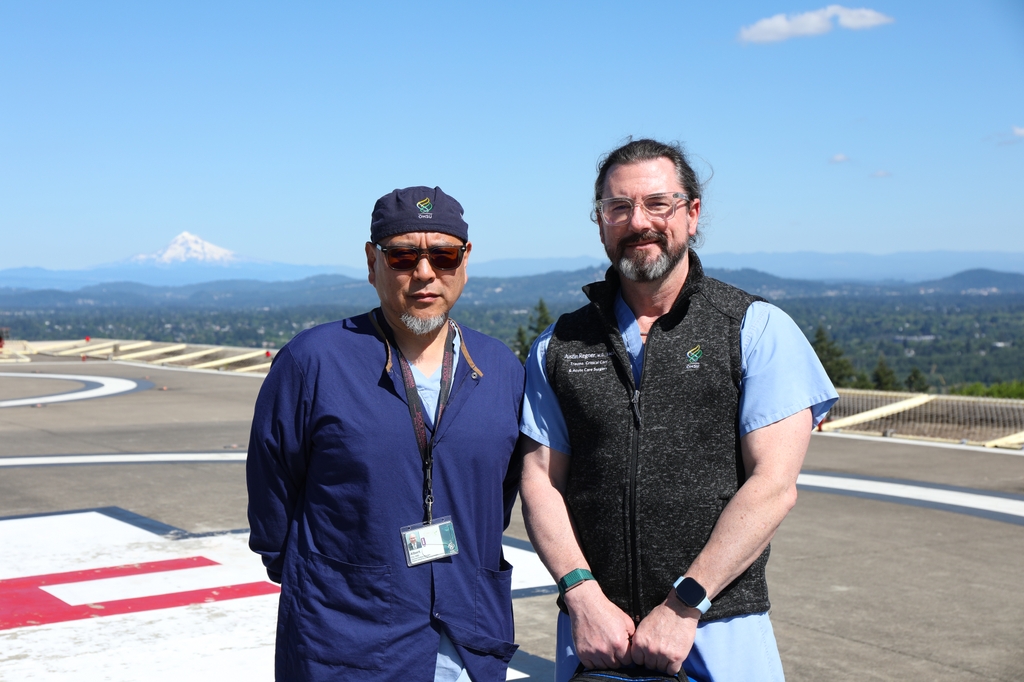
Trauma surgeon Albert Chi, M.D., had a clear view of Mount Hood as he lifted off from the roof of OHSU Hospital aboard a Life Flight helicopter on Sunday, May 24.

He received the initial call shortly after 10:30 a.m.: A car-size boulder had rolled on top of a climber descending the mountain above Timberline Lodge. The patient was alive and talking, but first responders struggled to extricate him as his condition was worsening in the cold mountain air, 6,500 feet above sea level.
Chi and his team from Oregon Health & Science University planned to amputate the patient’s leg to pull him off the mountain and save his life.
“Really, it’s life over limb,” he said.
Chi and OHSU resident surgeon Jesse Allen, M.D., arrived at the mountain within 20 minutes of lifting off from Portland. A second Life Flight helicopter was already on scene providing treatment and preparing to transport the patient off the mountain. Chi and Allen were hovering above the landing zone shortly after 12:30 p.m. when word came through the headsets: Rescuers successfully extricated the patient.
A palpable sense of relief surged through the cockpit.
“I was very happy for the patient,” Chi recalled. “We were ready to do what we needed to do, but we’re grateful for the extraordinary capability and resourcefulness of the search and rescue team on the ground. It was better for the patient — and that’s all I care about.”
‘It’s on us to get to the scene’

Justin Regner, M.D. FACS, the trauma medical director at OHSU, oversees the field surgical team and makes sure the team is prepared to deploy when and where needed within Oregon. The team has a “go-bag” packed and ready to go whenever it’s needed to deploy their expertise outside the walls of OHSU Hospital, whether by ground or air.
Those occasions have been rare and unpredictable.
“In dire circumstances, our patients actually need us to go to them,” Regner said. “In these rare moments when patients cannot be extricated or extricated in a timely manner, it’s on us to save their life.”

Heather Wong, RN, administrative director of OHSU’s trauma program, said the event on May 24 was the fourth time the field surgical team had been paged since it formed in 2018. Fortunately, in each case, first responders managed to extricate the patient without the need for a surgical amputation.
The incident on May 24 marked the first time the team actually departed OHSU for the field.
“These urban search and rescue teams are highly skilled, and they are the reason why we don’t get called as much,” Wong said. “They take a lot of pride in what they do, and they’ve always found a way.”
The incident demonstrated how emergency response has evolved through simulations, skill building and resourceful use of equipment, Wong said. Yet, the training will only go so far in the event of a catastrophic incident like a major earthquake caused by the Cascadia subduction zone — a geological scenario that mirrors the massive earthquake in Japan on March 11, 2011.
She said it’s a matter of time when OHSU’s services will need to be mobilized again.
“We are prepared for our field surgical teams to provide care well beyond the walls of the hospital,” she said. “We’re focused on bringing care to the patients where and when they need it.”
A test in real time
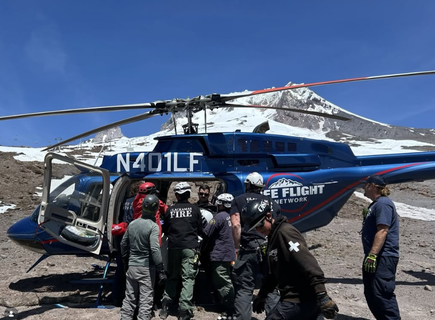
The event on May 24 amounted to a trial run in real time.
Chi was the trauma surgeon on call for OHSU’s field surgical team on the Sunday of Memorial Day weekend.
Earlier that morning, a 36-year-old Seattle-area resident was descending Mount Hood after summiting Oregon’s tallest peak with a friend. He was within half a mile of the parking lot at Timberline Lodge when he left the main trail and became pinned beneath a large boulder that gave way in a small landslide.
The underlying snow cushioned his leg such that it wasn’t crushed. Fellow hikers quickly called 9-1-1, but rescuers struggled to move the 16,000-pound boulder in challenging conditions.
The patient, who ultimately lost his middle finger and part of the index finger of his right hand in the initial impact, was treated at OHSU and discharged on May 27. He said he is recovering at his parents’ home in the Bay Area and grateful for the emergency responders and for the care he received at OHSU.
“I have a bit of pain here and there, but I’m mostly fine now,” he said.
Field simulation
Aside from being a beacon for Oregon outdoor recreation, Mount Hood defines the interior boundary of the Cascadia subduction zone. The Cascade Range is a line of volcanoes arising from tectonic forces that will, sooner or later, give way in the form of a subduction zone earthquake. In that scenario, OHSU’s field surgical team will likely be stretched to the maximum.
Yet, a catastrophic earthquake isn’t the only risk facing first responders.

“On a day-to-day basis, there are other risks that are more probable,” said Jonathan Jui, M.D., EMS medical director for Multnomah County and a professor of emergency medicine at OHSU. “A gas line could blow up at any time and you can have a rubble pile.”
In April, Jui joined first responders from Portland Fire & Rescue, AMR and the team from OHSU for a drill that involved a person trapped in a collapsed garage. The simulation resulted in an update within OHSU’s chain of communication to directly notify the trauma physician on call who, in turn, activates the field surgical team to be ready.
Barely six weeks later, the team activated exactly as planned when the call came on May 24.
“The inter-team training is critical to help first responders and hospital staff understand each team’s mission,” Jui said. “It’s almost like athletic practice where everyone needs to know the roles and responsibility of multiple members of the team.”
Life Flight also trains with OHSU on a regular basis.
The organization, owned by a consortium of four health systems, including OHSU, maintains a fleet of 65 helicopters and fixed-wing aircraft at dozens of bases spread across Oregon, Washington, Idaho, Montana and Hawaii. In the case of the rescue at Mount Hood, the network dispatched helicopters from bases in Hillsboro and Kelso, Washington.
Each Life Flight helicopter is staffed by a pilot, a certified flight nurse and flight paramedic.

“The coordination between OHSU’s surgical team and Life Flight Network demonstrates what is possible when delivering highly specialized care directly to the field in some of the most challenging conditions,” said Casey Seckel, chief clinical officer for Life Flight Network. “We are proud to work alongside OHSU and our regional partners to ensure that patients across our communities have access to the highest level of care, no matter how remote or complex the situation.”
Whether it’s a catastrophic regional disaster or an individual in dire need, OHSU health care professionals are prepared to respond where and when they’re needed.
The events of Memorial Day weekend won’t be forgotten anytime soon at OHSU.
“It was an incredible opportunity to have all the teams coming together,” Chi said. “It was OHSU at its best, EMS at its best — everyone coming together and collaborating out of concern for one individual who needed our help.”