
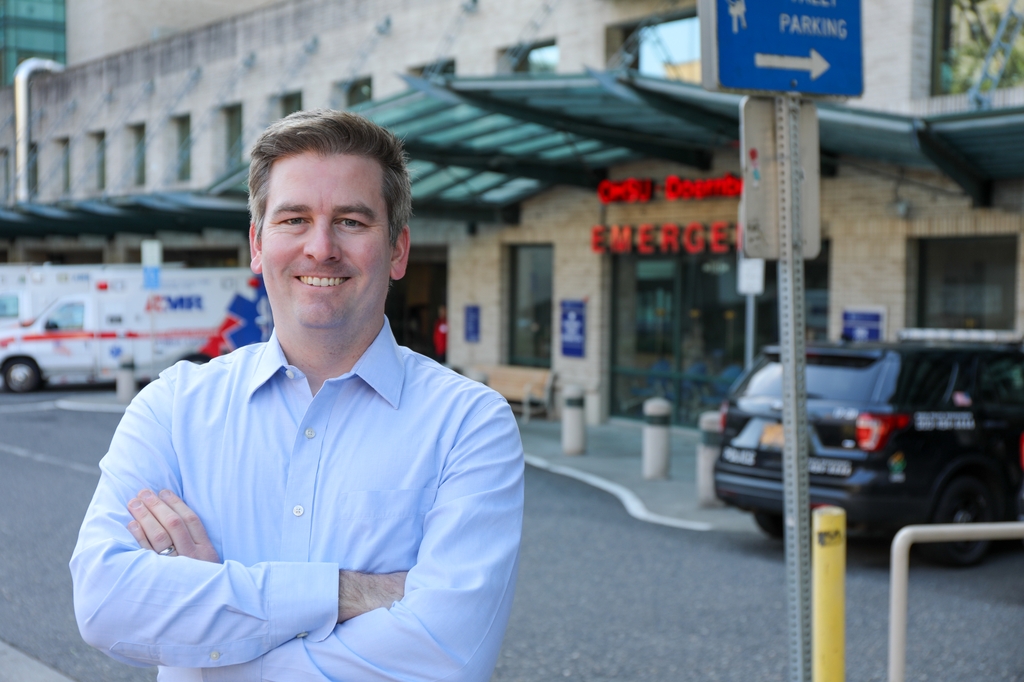
A team led by physician-scientists at Oregon Health & Science University has earned a $1.7 million, four-year award from the American Heart Association to study measures to improve survival of cardiac arrest.
Cardiac arrest strikes 600,000 times annually in the United States, with barely one out of 10 people surviving.
Joshua Lupton, M.D., M.P.H., M.Phil, assistant professor of emergency medicine in the OHSU School of Medicine, will lead the project with collaborators at OHSU, the University of Pittsburgh, University of Washington, Yale University and Mount Sinai.
Notably, Oregon already has the highest survival rate among all states — 14.1% — as measured by the Cardiac Arrest Registry to Enhance Survival in 2025.
The OHSU-led team will focus on improving care from the moment of emergency treatment through life after leaving the hospital. Researchers will examine how emergency responders administer electric shocks with defibrillators to restart a heart after cardiac arrest, specifically testing the effectiveness of different common placements of defibrillator pads.
OHSU researchers previously observed survival differences in pad placement through an observational study published in 2024; the new research will involve a clinical trial where first responders test alternate approaches.
That trial will be conducted in Oregon as an exception from informed consent trial.
“Medicine is full of examples where for one reason or another, observational studies suggest a benefit from one approach while a randomized clinical trial shows no benefit or even harm,” Lupton said. “This makes it critical to perform high-quality clinical trials, particularly for these life-threatening conditions.”
In addition, the OHSU-led project will use artificial intelligence to study how long emergency responders should wait between shocks during cardiac arrest. And, finally, researchers will focus on recovery after someone survives cardiac arrest — a topic that’s especially important to Lupton, who survived his own cardiac arrest as a medical student in Maryland in 2016.
Researchers noted that many survivors and their families feel unprepared after leaving the hospital.
“When people are discharged from the hospital after surviving cardiac arrest, the main focus is how to prevent another one,” Lupton said. “But we shouldn’t sell short the consequences of cardiac arrest itself, including neurological impacts involving a lack of blood flow to the brain and the emotional trauma.”
Researchers will contact cardiac arrest survivors to offer support and connections to peer-support programs comprised of other survivors. The goal is to study whether this type of support improves quality of life during recovery.
In addition to Lupton, the team includes Mohamud Daya, M.D., professor of emergency medicine, Matthew Neth, M.D., associate professor of emergency medicine, and Rochelle Fu, Ph.D., professor of biostatistics, each at OHSU; Ankur A. Doshi, M.D., FAHA, associate professor of emergency medicine at the University of Pittsburgh; Jason Coult, Ph.D., research assistant professor of medicine at the University of Washington; Alexander Presciutti, Ph.D., assistant professor of psychology at Mount Sinai; and Sarah Perman, M.D. associate professor of emergency medicine at Yale University.
The grant is part of a $3.4 million American Heart Association initiative enabling OHSU and another team of scientists to “undertake research studies to better understand how to predict and detect cardiac arrests, with a goal of ultimately improving treatment and survival rates and enhancing the recovery and quality of life for survivors and their families.”