Research at OHSU
Oregon Health & Science University provides a curated selection of high-resolution photos, video footage, b-roll and graphics for news organizations and media coverage related to OHSU stories. Commercial use is prohibited without prior written consent.
Media usage guidelines
- Photos and video should be credited as “OHSU/Photographer name.”
- Metadata includes captions and usage restrictions.
- Color correction and cropping are allowed. The content or nature of the photo may not be altered.
Questions or requests: Please contact OHSU Strategic Communications at news@ohsu.edu or 503-494-8231.

Video: Grab glass tube walk in lab
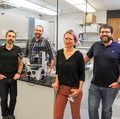
Researchers work in a laboratory at OHSU. Collaborative teams across disciplines pursue discoveries that deepen scientific understanding and support the development of future therapies, technologies and health care innovations. (OHSU/Christine Torres Hicks)

Research collaboration at OHSU
Researchers at OHSU frequently collaborate across disciplines, combining expertise from multiple fields to advance scientific discovery and improve human health. From investigating the body's complex biological systems to developing new vaccines, medications and treatments, interdisciplinary teamwork drives innovation across the university. (OHSU/Christine Torres Hicks)

Research collaboration at OHSU
Collaboration is at the heart of research at OHSU. Scientists, physicians and research staff regularly combine their expertise across disciplines to better understand disease, improve health outcomes and develop the next generation of therapies and medical breakthroughs. (OHSU/Christine Torres Hicks)

Researcher looking at a tissue slide in OHSU lab
A researcher examines a microscope slide while studying optic nerve tissue in an OHSU laboratory. The research is part of ongoing efforts to develop stem cell-based therapies for optic nerve damage and vision loss. (OHSU/Christine Torres Hicks)

VIDEO: Scope work up close
Microscopy equipment in an OHSU laboratory where researchers study optic nerve tissue and stem cell-based approaches to treating optic nerve damage and vision loss. (OHSU/Christine Torres Hicks)

Researcher prepares imaging equipment in OHSU oral microbiome laboratory
A researcher cleans and prepares microbiology imaging equipment used to study oral bacteria and the microbial communities associated with tooth decay and oral health. Researchers at the OHSU School of Dentistry investigate how microbes interact and contribute to disease. (OHSU/Christine Torres Hicks)

Oral bacteria culture grown in OHSU research laboratory
Gloved hands hold a petri dish containing cultured oral bacteria in an OHSU School of Dentistry lab. Researchers study bacterial growth, biofilm formation and microbial interactions to develop new approaches for preventing and treating oral diseases, including tooth decay. (OHSU/Christine Torres Hicks)

Bacterial samples prepared for oral microbiome research at OHSU
Laboratory tubes containing bacterial samples are organized for analysis in a lab at Oregon Health & Science University. OHSU researchers investigate the oral microbiome, including beneficial and disease-causing bacteria, to better understand oral health and develop targeted treatments. (OHSU/Christine Torres Hicks)

Advances in kidney research
A researcher holds a microscope slide containing kidney tissue at OHSU. Researchers identified a protein that functions as a pressure sensor in the kidney, a discovery that sheds light on how the body regulates fluid balance and blood pressure and may inform future research on kidney disease. (OHSU/Christine Torres Hicks)

Advanced microscopy
Specialized imaging equipment glows red in a darkened OHSU lab. Using advanced microscopy techniques, researchers study cancer across molecular and cellular scales, supporting earlier detection and the development of new treatments. (OHSU/Christine Torres Hicks)

Advanced microscopy
Specialized imaging equipment glows in a darkened lab at OHSU. Researchers use advanced imaging tools and techniques to study cancer at the molecular level, advancing early detection and new approaches to treatment. (OHSU/Christine Torres Hicks)

Advancing vaccine research
A researcher examines blood samples for vaccine research at Oregon Health & Science University’s Vaccine & Gene Therapy Institute. (OHSU)

Artificial blood vessel research
A simulated blood vessel glows turquoise under a microscope in an OHSU lab. OHSU researchers are part of an international initiative to develop artificial blood vessels that replicate key features of human circulation, advancing research into clotting and cardiovascular disease. (OHSU/Christine Torres Hicks)

Bacteria research
A researcher sterilizes tools over an open flame in an OHSU lab. In a study published in Nature, OHSU researchers found that a dangerous strain of E. coli can block immune defenses to spread infection, pointing to new treatment approaches that target how bacteria cause disease. (OHSU/Christine Torres Hicks)

Biofabrication lab
Specialized equipment glows in an OHSU biofabrication lab, where researchers develop advanced models such as organoids and organs-on-a-chip. These technologies allow scientists to study cancer in its earliest stages and better replicate the human body’s environment, offering new insights into how the disease begins. (OHSU/Christine Torres Hicks)

Breakthroughs in cancer research
A researcher presents a panel showing cancer cells at different stages. OHSU researchers discovered that certain nerves may support pancreatic tumor growth, a finding that could guide new treatment strategies. (OHSU/Christine Torres Hicks)

Cellular cryo-electron tomography
Color-coded samples are stored in a cryogenic freezer supporting cryo-electron microscopy at OHSU. The technology, including cryo-electron tomography, enables researchers to visualize cells at near-atomic resolution and capture high-resolution 3D images, advancing understanding of human health and disease. (OHSU/Christine Torres Hicks)

Center for Experimental Therapeutics translates lab discoveries to treatments
The Center for Experimental Therapeutics at the OHSU Knight Cancer Institute supports the development of new medicines by providing expertise in pharmacology, toxicology and chemistry, along with advanced screening services and model systems to translate discoveries into potential treatments. (OHSU/Christine Torres Hicks)

Driving new treatments
Laboratory tools and samples line a research bench at OHSU. From early discovery to translational science, OHSU researchers work to advance understanding of human health and drive new treatments. (OHSU/Christine Torres Hicks)

From science to clinical applications
A researcher uses a pipette under a laboratory hood at OHSU. From basic science to clinical applications, OHSU researchers conduct studies that advance understanding of human health and support the development of new treatments. (OHSU/Christine Torres Hicks)

Maternal Fetal Medicine Research Unit at OHSU
Research assistants Olivia Hagen and Lorraine Codding work in the Maternal Fetal Medicine Research Unit at Oregon Health & Science University. Known as the “Pregnancy Research Group,” the team has supported studies involving pregnant individuals for more than 15 years. (OHSU/Christine Torres Hicks)

Molecular level
Specialized imaging equipment glows in a darkened lab at OHSU. Researchers use advanced imaging tools and techniques to study cancer at the molecular level, advancing early detection and new approaches to treatment. (OHSU/Christine Torres Hicks)

Novel cancer treatment research
Li Xiang, Ph.D., postdoctoral scholar at the OHSU Knight Cancer Institute, and Michael Henderson, B.A., a biomedical engineering Ph.D. student, are part of a research team at Oregon Health & Science University that developed a new nanoparticle designed to make cancer treatment safer and more effective. (OHSU/Christine Torres Hicks)

OHSU research advances standards of care
A microscope glows in a darkened lab, highlighting research underway at OHSU. As Oregon’s only academic health center, OHSU advances discoveries that deepen understanding of human health and drive new treatments and standards of care. (OHSU/Christine Torres Hicks)

Organs-on-a-chip research and technology
A researcher holds a biofabrication tool tip in an OHSU lab, where scientists create advanced models such as organoids and organs-on-a-chip. These technologies allow researchers to study cancer in its earliest stages and better mimic the human body, offering new insight into how the disease begins. (OHSU/Christine Torres Hicks)

Participants of pioneering CRISPR gene editing trial see vision improve
Surgeons at the OHSU Casey Eye Institute led the first in-body CRISPR gene editing procedure in 2020 as part of the Phase 1/2 BRILLIANCE clinical trial. Updated results show most participants with a rare inherited form of blindness experienced measurable improvement after receiving the experimental treatment. (OHSU/Kristyna Wentz-Graff)

Research at OHSU
Laboratory tools and samples are arranged on a research bench at OHSU. As Oregon’s only academic health center, OHSU conducts a wide range of scientific research aimed at advancing understanding of human health and developing new treatments. (OHSU/Christine Torres Hicks)

Tech in science
A researcher inputs data linked to laboratory instruments at OHSU. Integrated technologies enable scientists to monitor experiments, analyze complex data, and accelerate research discoveries. (OHSU/Christine Torres Hicks)

Vaccine Studies
Researchers process blood samples for research at Oregon Health & Science University. The work supports studies in vaccine development and immune response. (OHSU)
- Latest Stories
- Popular

La 22.ª Subasta Freestyle de Doernbecher recauda una cifra récord de más de 2.4 millones de dólares

Accolades: Awards, honors and accomplishments October
Investigadores(as) de OHSU obtienen $12.5 millones para estudiar la ubiquitina, una molécula fundamental en la salud y la enfermedad
22nd Doernbecher Freestyle auction raises over $2.4 million, a record

Adults don’t need tetanus, diphtheria boosters if fully vaccinated as children, study finds
Accolades: Awards, honors and accomplishments October