NICU music therapy
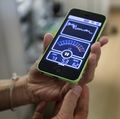
A decibel meter is used to monitor volume, which is critical in the NICU environment. “The babies physiologically are very sensitive, many of them are underdeveloped in terms of their hearing abilities," says certified music therapist Laura Beer, who donates her time to the OHSU Doernbecher Children's Hospital NICU. "We have to be very careful to keep our playing under 70 decibels.” (OHSU/Kristyna Wentz-Graff)
NICU music therapy
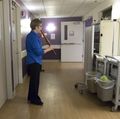
Certified music therapist Laura Beer plays a flute in an empty hallway in the OHSU Doernbecher Children's Hospital NICU. “The babies physiologically are very sensitive, many of them are underdeveloped in terms of their hearing abilities," says certified music therapist Laura Beer, who donates her time playing on the unit. "We have to be very careful to keep our playing under 70 decibels.” (OHSU/Kristyna Wentz-Graff)
NICU music therapy
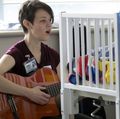
Marylhurst University student Whitney McCann sings for a child at the Doernbecher Children's Hospital NICU, December 1, 2016. Research has shown that live music in neonatal units can help lower the heart and respiratory rates in premature babies, as well as increase their oxygen level, and improve sucking response. (OHSU/Kristyna Wentz-Graff)
NICU music therapy
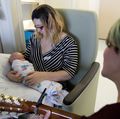
Sondra George holds her three-week-old son, William George, as Whitney McCann plays him a lullaby at the Doernbecher Children's Hospital NICU, December 1, 2016. Research has shown that live music decreases stress levels for babies in hospital settings. (OHSU/Kristyna Wentz-Graff)

Shoukhrat Mitalipov Ph.D.
Research Week 2017: A new approach to permanent birth control for women
Research Week 2017: ‘How can we use our brains to understand our brains?’
Research Week 2017: Why should anyone care about aflatoxins? Communicating the need for basic science around the world
New study outlines financial incentive for in-hospital opioid intervention program
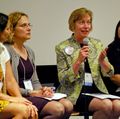
9th Annual Health Care Symposium
Renee Edwards, M.D., M.B.A., physician at the OHSU Center for Women’s Health, speaks on a panel at the 9th Annual Health Care Symposium held April 20, 2017 at OHSU's Collaborative Life Sciences Building in Portland. (Virginia Garcia Foundation/Wendy Owen)
