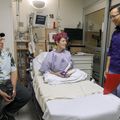
Awake craniotomy with language mapping
(Left to right) Tom Quick, and his wife Bonnie meet with her neurosurgeon, Seunggu Jude Han, M.D., just before Bonnie goes in for brain surgery on October 4, 2019. OHSU performs 40-50 awake craniotomies with language mapping annually. (OHSU/Kristyna Wentz-Graff)
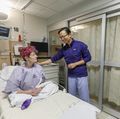
Awake craniotomy with language mapping
Bonnie Quick meets with her neurosurgeon, Seunggu Jude Han, M.D., just before she goes back for brain surgery on October 4, 2019. OHSU performs 40-50 awake craniotomies with language mapping annually. (OHSU/Kristyna Wentz-Graff)
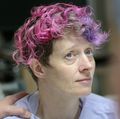
Awake craniotomy with language mapping
Bonnie Quick meets with medical teams before her surgery at OHSU. OHSU performs 40-50 awake craniotomies with language mapping annually. (OHSU/Kristyna Wentz-Graff)

Kim Burchiel, M.D.
Professor and past chair, Department of Neurosurgery; OHSU School of Medicine. (OHSU)
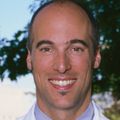
Matthew Brodsky, M.D.
Matthew Brodsky, M.D., medical director of OHSU’s deep brain stimulation program. (OHSU)
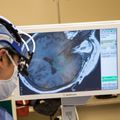
Deep brain stimulation
Typical deep brain stimulation procedures are performed while the patient is awake. Technological improvements in imaging have enabled neurosurgeons at OHSU to accurately map the brain before and during deep brain stimulation, allowing them to conduct the surgery while the patient is fast asleep. (OHSU/John Valls)
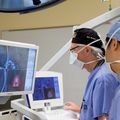
Deep brain stimulation
Kim Burchiel, M.D., (center), past chair and professor of neurosurgery in the OHSU School of Medicine. (OHSU/John Valls)
VIDEO: Mission Control at OHSU
Revisión: un medicamento para el trastorno de pánico resulta menos eficaz de lo que se creía