
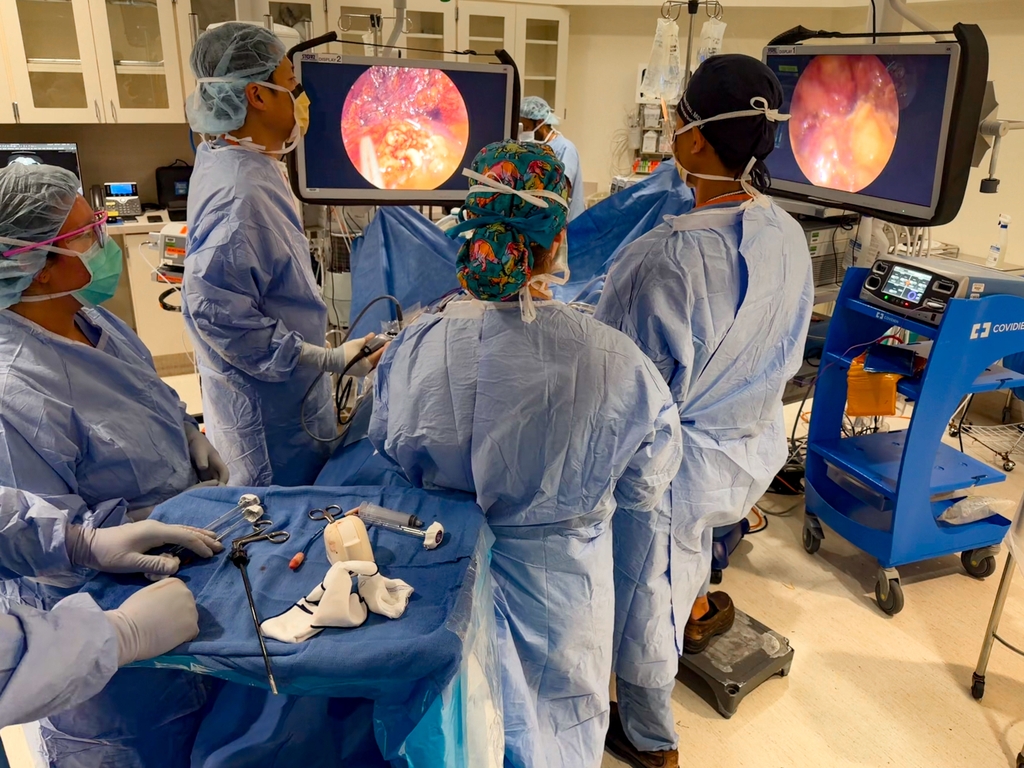
An Ashland resident with Cushing’s syndrome is the first in Oregon to have both of her adrenal glands removed simultaneously in a pioneering surgery at Oregon Health & Science University.

The bilateral adrenalectomy is typically performed in sequence, in an operation that would normally occur over four or five hours. By having two surgeons operate simultaneously through the patient’s back, they eliminated the need to turn the patient and reduced the time of the procedure by about half.
It marked the latest milestone in surgical innovation for OHSU, the state’s academic medical center.
“It went very smoothly,” surgeon Shawn Hsu, M.D., said.
“It’s always nice to operate with a colleague,” added his colleague and fellow surgeon James Lim, M.D.

For patient Raven Stamper, 29, the bilateral adrenalectomy on May 5 ended a long and winding medical mystery that turned out to be caused by a rare iteration of Cushing’s syndrome, when the body is exposed to excess cortisol. The condition was made famous by comedian Amy Schumer two years ago. Stamper is recovering and getting ready to go back to work as a massage therapist in Southern Oregon.
“I’m incredibly grateful for everybody from OHSU,” she said. “I felt super safe and taken care of, and in the best hands that I could be. I’m very, very appreciative.”
An ideal case

Lim, associate professor of surgery (surgical oncology) in the OHSU School of Medicine, is one of a handful of surgeons in the Pacific Northwest with advanced fellowship training in endocrine surgery, specifically thyroid, parathyroid and adrenal surgeries. After Hsu arrived in 2024, having trained in the same surgical fellowship at Columbia University, Lim looked for an opportunity to join with Hsu to perform the procedure simultaneously on one patient.
Stamper’s case was ideal.
“They told me the surgery time would be cut in half, with less time under anesthesia,” she said. “That sounded good to me.”
The team accessed the adrenal glands simultaneously through her back as opposed to through the abdomen. This retroperitoneal approach can only be performed by adrenal surgeons with specialized training and is the only way to access both adrenal glands simultaneously — and only if a second surgeon with the requisite expertise is available.
“It was interesting to be able to do it at the same time and manage the logistics of two surgical teams,” Lim said. “It was great to be able to perform this successfully for the patient’s benefit.”
A rare condition
Cushing’s syndrome occurs when the body is exposed to an overabundance of the cortisol hormone.
Reasons can vary, but in rare cases — estimated to be less than 2% — it’s caused by a disorder of the adrenal glands causing them to produce excess cortisol. The adrenal glands, each about the size of a small lime, sit on top of each kidney. They produce hormones including cortisol, usually at the direction of the pituitary gland in the brain that regulates the body’s endocrine system.

“In rare cases, the adrenal glands develop these small nodules that autonomously produce cortisol regardless of what the pituitary gland is doing,” said neuroendocrinologist Elena Varlamov, M.D., associate professor of neurological surgery and medicine (endocrinology, diabetes and clinical nutrition) in the OHSU School of Medicine and part of the OHSU Pituitary Center.
Varlamov diagnosed Stamper after she was referred from her primary care physician and then a specialist in nearby Medford.
She said the surgery was the culmination of a series of mysterious symptoms dating back to her teenage years growing up in Ashland. The most noticeable involved bruising easily, which can be caused by excess cortisol thinning the skin. Over time, such an excess of cortisol can lead to potentially lethal conditions, including heart disease, infections and diabetes. It also leads to osteoporosis, or loss of bone density.
Now that she’s had the procedure, she will be on lifelong medication to replace the hormones normally produced by the adrenal glands.
Stamper said she’s excited to lay the medical mystery to rest.
“I’m feeling great,” she said. “I’m very excited to have my cortisol levels go down enough that I can get on with my life.”